Most freelancers who get paid late blame the client. Often the real problem is the invoice. A vague due date, missing payment instructions, a line-item description that raises more questions than it answers — each one adds friction between the client and your money, and friction is the enemy of getting paid on time.
Writing a professional invoice isn't complicated, but there's a right way to do it. The difference between an invoice that gets processed immediately and one that sits in someone's inbox for three weeks usually comes down to a handful of details — most of which take about two minutes to get right.
This guide covers everything: what to include, how to phrase it, how to set payment terms that actually hold up, and what to do when a client goes quiet anyway.

Photo by www.kaboompics.com on Pexels
What every professional invoice needs to include
A missing field isn't just a minor oversight — it's a reason for a client's accounts payable team to put your invoice in a "needs more info" pile that nobody checks until you follow up. Make sure every invoice you send has all of these:
- Invoice number — unique and sequential. Both you and your client need this to refer to a specific payment.
- Your name or business name + address, email, and phone number
- Client's name or company name + billing contact + address
- Invoice date — the date you're sending it
- Due date — a specific date, not "Net 30" alone (more on this below)
- Itemized services — description, quantity or hours, rate, and line total for each item
- Subtotal, taxes if applicable, and total amount due
- Payment methods you accept
- Your payment details — bank transfer info, payment link, PayPal address, etc.
- Late fee clause — optional, but worth adding to every invoice
If any of those are missing, add them now. If your current invoice template doesn't have a slot for late fee terms, create one.
How to write a professional invoice: step by step
Header information
Your name and the client's name belong at the top. Add your logo if you have one — it takes ten seconds and makes the document look like it came from a real business, not a Google Doc someone threw together after the project wrapped. Include your business address, email, and phone, even if you don't expect anyone to call. A complete header reduces the chance an invoice gets passed around internally without context and ends up in the wrong hands.
Line items and descriptions
Be specific without being exhausting. "Brand strategy — Q2 2026 (20 hours @ $125/hr)" tells the client exactly what they're paying for and why. "Consulting services" tells them nothing and invites questions — which delay payment.
Each line item should include a clear service description, quantity or hours worked, your rate, and the line total. If a project had multiple phases or deliverables, break them into separate lines. More detail creates less confusion, and less confusion means faster payment.
Totals and taxes
Show the subtotal first, then any applicable taxes on their own line, then the total due — ideally in a slightly larger or bolder font so it's impossible to miss. If you applied a discount, collected a deposit, or split payment into milestones, include those as line items too. Transparency here prevents disputes when the client compares your invoice to what they thought they agreed to.
Payment instructions
Tell clients exactly how to pay. Bank transfer details, a link to your payment page, a PayPal address — whichever you prefer, it should be on the invoice itself, not buried in an email or stored in a thread from three months ago. The fewer steps between "I want to pay this" and "I have paid this," the faster you get paid. If you use an invoicing tool with online payment, a "Pay Now" button does a surprising amount of work.
How to set payment terms that hold up
Net 30 is the default, but it isn't always the right call. Different situations call for different terms:
- Due on receipt — best for new clients, small one-off projects, or anyone who has paid late before
- Net 7 or Net 14 — good for ongoing work with established clients who have a track record of paying promptly
- Net 30 — standard for larger organizations; expect them to use all 30 days
- 50% upfront, 50% on delivery — the right call for large projects, new clients you don't know well, or anything that requires significant time before you see a payment
Whatever terms you choose, write the actual due date on the invoice — not just "Net 30." A due date of August 7 is harder to ignore than Net 30, which requires the client to do math before they even know when they're supposed to pay.
Late fee clause: add something like "A late fee of 1.5% per month will be applied to overdue balances" to every invoice. Most clients will never pay it, but it signals that you track these things and that you're serious about being paid on time. That alone tends to change behavior.
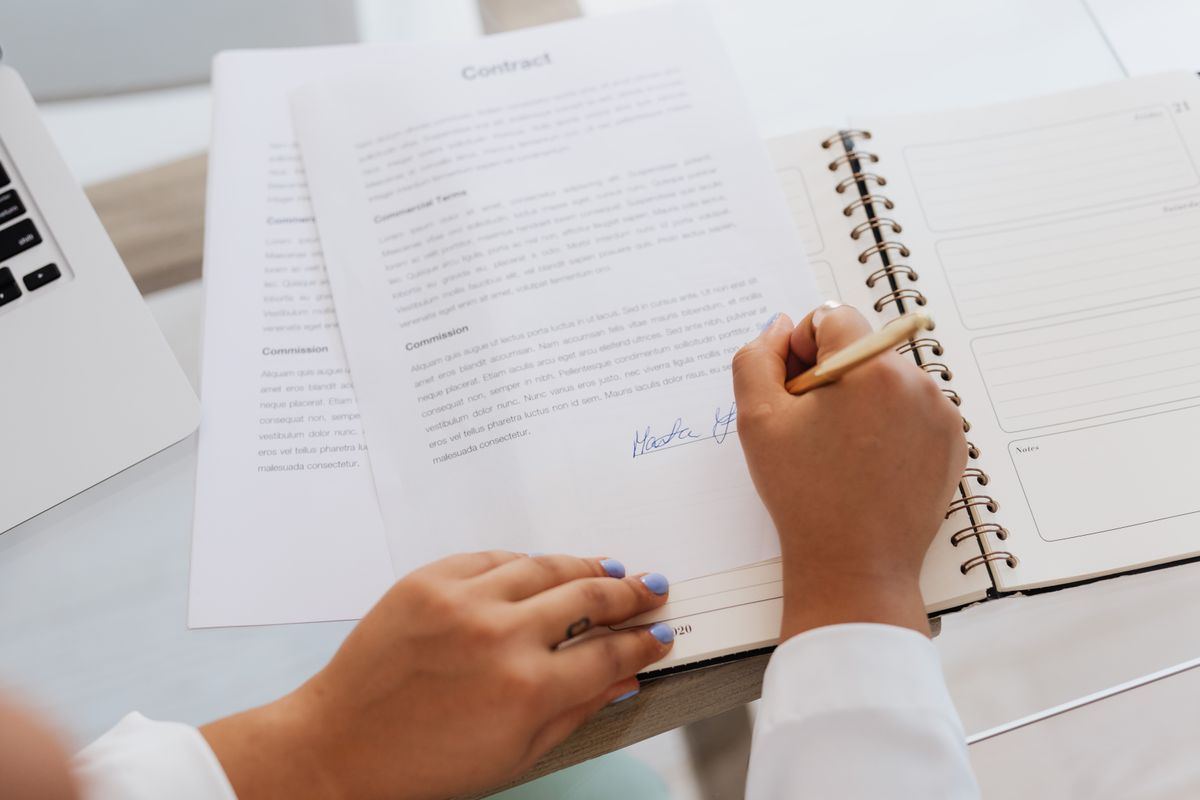
Photo by www.kaboompics.com on Pexels
What to do when a client pays late
A late fee on your invoice is one thing. Actually following up is the part that matters. Most unpaid invoices don't get resolved through escalation — they get resolved through the first reminder, which most freelancers wait too long to send.
- Friendly reminder. Assume it was an oversight, not a decision. A short email — "Just flagging that invoice #042 was due today, attaching again for reference" — is enough. Keep the tone warm.
- Direct follow-up. "Circling back on invoice #042, still showing as unpaid on my end. Let me know if there's anything you need from me to process it." Professional, not accusatory.
- Reference the late fee. "Per our invoice terms, a late fee is now being applied to the outstanding balance. I'd like to get this resolved — can you give me a status update?" The tone shifts slightly. That's intentional.
- Formal notice. At this point you're building a paper trail. If the amount warrants it and you've exhausted direct channels, small claims court or a collections service enters the picture. Keep all your correspondence.
The majority of late invoices get resolved before day 14. The ones that don't usually have a bigger problem behind them — a dispute about the work, a cash flow issue on the client's end, or a contact who left the company. The sooner you follow up, the sooner you find out which it is.
Tools that make invoicing faster
If you're still building invoices manually in Word or a PDF template and emailing them as attachments, you're creating extra work for yourself and adding friction for your client. Purpose-built invoicing tools like HoneyBook and Bonsai let you create clean, branded invoices in minutes, collect payment online, and send automatic reminders when a due date passes — without you having to track anything manually. FreshBooks does all of that while keeping your income and expenses organized for tax season at the same time.
Frequently asked questions
What is the difference between an invoice and a receipt?
An invoice is a request for payment — it goes out before money changes hands. A receipt confirms that payment was received. You need both, and they serve different purposes for your records and your client's.
What payment terms should I use for a new client?
Start with 50% upfront and 50% on delivery. Once you've completed a few projects with a client and trust is established, you can relax to Net 14 or Net 30. Deposits also protect you if a project gets canceled partway through.
Can I charge a late fee on an unpaid invoice?
Yes, as long as you stated the late fee terms on the original invoice. An after-the-fact fee is harder to enforce. Add a late fee clause to every invoice upfront — something like 1.5% per month on overdue balances — and most clients will treat it as a useful nudge rather than a surprise penalty.
Do I need to include my tax ID on a freelance invoice?
In the US, generally not for standard freelance invoices. Some larger companies may request your EIN or SSN before processing payment — in that case they'll typically ask you to complete a W-9. Check whether your state has any additional requirements for your situation.
How should I number my invoices?
Any consistent system works. Most freelancers use sequential numbers (001, 002, 003) or a year-based format (2026-001). The goal is a unique identifier that you and your client can both reference when discussing a specific payment — without having to dig through email threads to figure out which one.