In one 2026 study, fewer than one freelancer in ten said they'd tell a client about their AI use without being asked. A quarter of clients expected exactly that. So do you have to tell clients you use AI? The answer is less comfortable than either side assumes.
The short version: no general law makes you tell clients you use AI. Three things can: your contract, the platform you work through, and a handful of rules about specific kinds of content. And even where nothing forces you, telling the client once, up front, is the safer move whenever AI has shaped what you hand over.
Below: what Fiverr and Upwork actually require, why a promise in your contract about who owns the work matters more than any AI law, what clients really expect, and wording you can paste into a quote. This is a practical guide, not legal advice. If a contract is worth a lot to you, have a lawyer read it.

Photo by Jep Gambardella on Pexels
Do you have to tell clients you use AI? What the law says
In the US, no general law requires a freelancer to announce which tools they used, AI included. The obligations that do exist are narrower, and they come from three places.
- Your contract. If it says no AI, or asks you to disclose it, that's binding. So are the quieter clauses: a promise that the work is original, that the client will own it, or that their information stays confidential.
- Your platform. Fiverr and Upwork both have rules, covered in the next section.
- Rules about specific content. The EU's AI Act, for example, has required since August 2026 that anyone publishing a deepfake says it's artificial. The same goes for AI-generated text published to inform the public on matters of public interest, unless a person has reviewed it and someone takes editorial responsibility for it. That exception covers most client work a freelancer edits and signs off.
Regulated professions are a separate case. Lawyers, financial advisers and similar fields answer to their own professional rules, which can ask for more than the law does.
What Fiverr and Upwork require
Fiverr allows AI in every service category and doesn't make you list your tools. Its AI guidelines go as far as warning clients that freelancers don't necessarily mention everything they use, so a client who wants no AI has to say so.
Two things are required of you, though. If a client asks for non-AI work, before or at the start of an order, you have to honour that and explain how you plan to work. And you can't misrepresent it. Fiverr names deception about how work was delivered, and misrepresenting AI use, as breaches of trust. The consequences it lists are a cancelled order, a full refund for the client and, at worst, permanent suspension. It also expects AI-assisted work to be meaningfully reworked for the client: generic, unmodified output doesn't meet its standard.
Upwork gets to the same place from a different direction. Its terms of use count it as misrepresentation to use generative AI to substantially bolster your proposals or your work when the client has restricted it, or when it infringes someone else's rights. No restriction, no breach. But once a job post or contract says no AI, using it quietly is a terms violation, not a grey area.
The pattern is the same on both. You aren't required to volunteer it, you are required not to lie about it, and a client's stated preference wins.
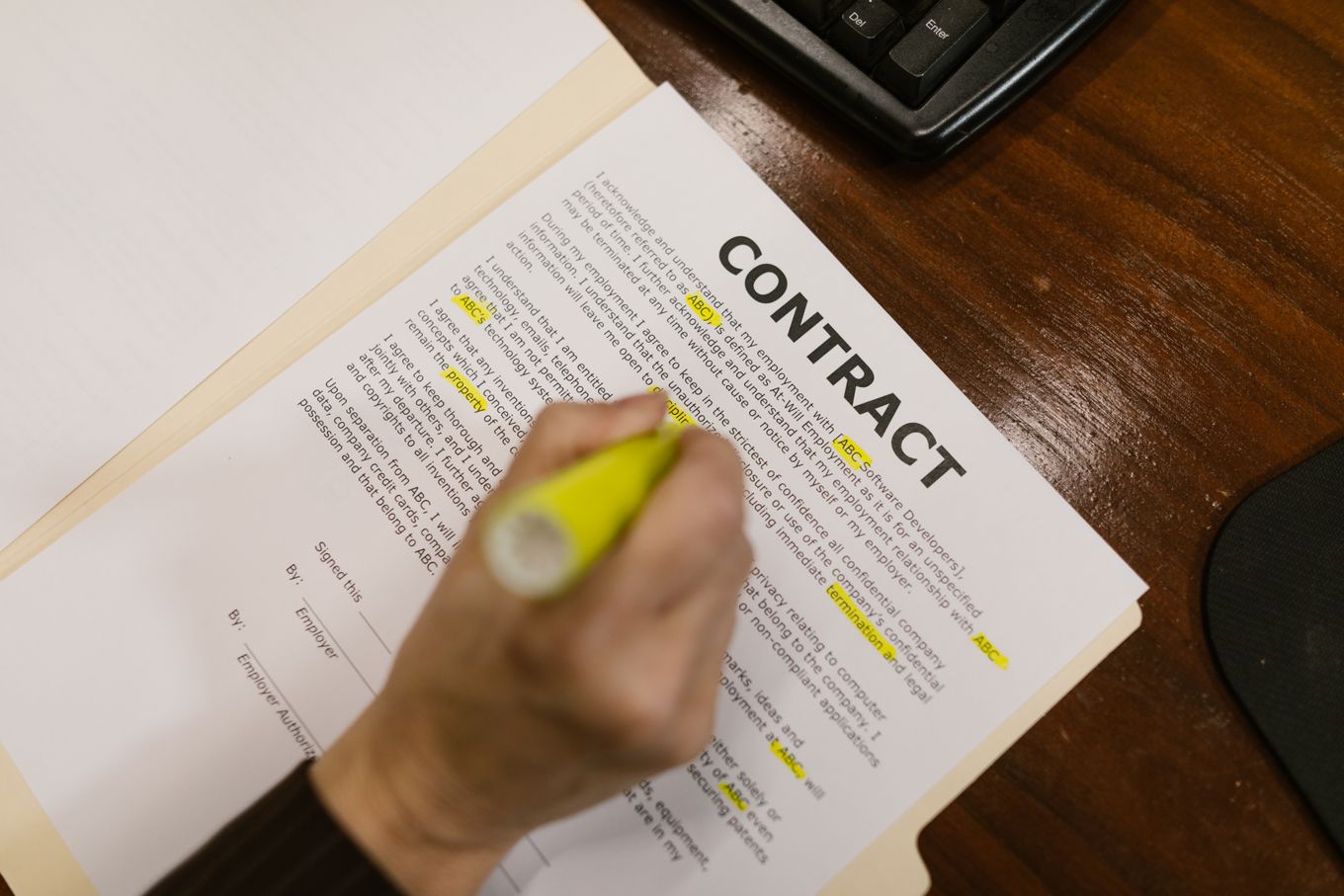
Photo by RDNE Stock project on Pexels
The clause that matters more than any AI law
Most freelance contracts say the client will own what you deliver, and many add that the work is original. Here's the catch. The US Copyright Office concluded in January 2025 that AI output can be protected by copyright only where a human author has determined enough of its expressive elements. Arranging, modifying or building on AI material can qualify. Writing a prompt, on its own, does not.
So if you hand over an image or a block of text that came straight out of a generator, and your contract says the client owns the copyright, you may have promised them something that doesn't exist. Nobody has to prove you hid anything for that to be a problem. The promise itself was wrong.
The same report has a reassuring half. Using AI to help you create doesn't cost you protection, and neither does including some AI-generated material in a larger work you made. A draft you rewrote, a layout you built around a generated texture, code you restructured and tested: that's your work, with a tool involved.
Two smaller clauses deserve the same look. One is confidentiality: pasting a client's documents into an AI tool can break a non-disclosure agreement whether or not the output ever appears in the work. The other is any client AI policy the contract refers to, which some larger clients now have.
What clients actually expect
A 2026 study asked 100 freelancers and 145 clients on freelance platforms about exactly this. It's a small sample, but the two sides disagree in a consistent way.
- About 79% of the freelancers used AI in their work.
- 81% of clients encouraged AI use in some form. Only 14% discouraged it entirely.
- 78% of clients said they'd permit AI on their tasks, but only 66% of freelancers believed they were allowed to use it.
- 26% of clients expected to be told without asking. Under 9% of freelancers said they would do that.
Why the silence? Nearly two-thirds of the freelancers believed clients could usually spot AI-assisted work just by looking at it, so telling them felt redundant. The clients were far less sure they could.
So freelancers stay quiet because they assume clients already know, and clients don't ask because they assume they'd have been told. It's the professional version of two people each waiting for the other to text first.
The useful part is how relaxed the clients turned out to be. Most were more open to AI than their freelancers assumed. What they wanted was to hear about it from the freelancer, not to work it out for themselves.
When to tell clients, and when you don't need to
Not every use of AI needs announcing. A simple way to sort it:
- No need: AI as a background tool. Spellcheck, grammar suggestions, autocomplete, transcribing your own notes, search. Nobody discloses their dictionary either.
- Say it once, up front: AI shaped the work and you finished it. Research, first drafts, concept sketches, scaffolded code that you then rewrote, checked and stand behind. One line in the proposal or quote covers it.
- Always, before you start: the AI output is the deliverable (generated images, a synthetic voice, lightly edited text), the client's confidential material would go into an AI tool, the client has said they don't want AI or has a policy, or you work in a regulated field.
One rule sits above all three: if a client asks, tell the truth. Every platform penalty and most of the contract risk above comes from misrepresenting AI use, not from using it.
How to tell clients you use AI
Disclosure works best as a calm line in your paperwork, not a confession halfway through a project. Put it where the scope and price already live.
That covers what you use it for, who's accountable, the confidentiality point and the client's right to say no. Our quote generator has a terms and conditions field that suits exactly this kind of line.
If a client does ask for no AI, you have two honest options: do the work without it and price the extra hours, or turn the job down. Agreeing and then using it anyway is the one choice that breaks the platform rules and the contract at the same time.
What disclosure doesn't mean is a discount. If the client gets the same result, the work is worth the same, and we make that case in should you charge less if you use AI?
Frequently asked questions
Do you legally have to tell clients you use AI?
In the US, no general law requires it. The duty usually comes from somewhere more specific: a clause in your contract, the rules of a platform like Fiverr or Upwork, or rules about particular kinds of content, such as the EU's requirement to label deepfakes. Regulated professions can have stricter rules of their own.
Do I have to disclose AI use on Fiverr or Upwork?
Neither platform makes you list your tools. Fiverr requires you to honour a client's explicit request for non-AI work, and treats misrepresenting AI use as a breach of trust that can end in a cancelled order, a refund and suspension. Upwork's terms treat using generative AI as misrepresentation when the client has restricted it.
Can clients tell if I used AI?
Less often than freelancers think. In a 2026 study, nearly two-thirds of freelancers believed clients could usually spot AI-assisted work, while clients were far less confident that they could. Don't base the decision on whether you'd be caught. Base it on what you agreed to.
Who owns work I made with AI?
It depends how much of it is yours. The US Copyright Office says AI output is protected by copyright only where a human author determined enough of its expressive elements. A prompt alone isn't enough, but work you substantially wrote, arranged or modified still qualifies. If your contract promises the client ownership, handing over raw AI output is a risk.
Should I charge less if I tell a client I use AI?
No. Disclosure is about trust and contract terms, not price. If the client gets the same result, the work is worth the same. The better fix is to price by project, so the time AI saves you doesn't shrink the invoice.